Demystifying Salesforce’s Agentic AI: Copilot, Prompt Builder & Agentforce Explained
AI isn’t just “nice to have” anymore — it’s becoming the engine behind faster decision-making, smoother workflows, and smarter experiences. And at the heart of Salesforce’s AI evolution lies its Agentic AI framework: Einstein Copilot, Prompt Builder, and Agentforce.
This article kicks off my new series on Agentic AI 🤖✨ where I break down concepts, real-world use cases, best practices, and hands-on tutorials.
Welcome to Part 1!
🌟 What Is Agentic AI?
In simple terms, Agentic AI means AI that not only answers questions but takes actions.
It doesn’t just respond — it executes, decides, and automates, based on natural language instructions.
Salesforce brings this to life with:
🧠 Einstein Copilot
A conversational AI assistant that lives inside Salesforce and can:
- Generate responses
- Summarize
- Draft content
- Pull Salesforce data via grounded reasoning
- Execute actions using skills
🧱 Prompt Builder
Configure grounded prompts, connect them with data using Prompt Templates, and test outputs — the bridge between natural language and structured Salesforce logic.
🤝 Agentforce (AI Agents)
These are autonomous, multi-step agents that can:
- Follow workflows
- Trigger automations
- Make decisions
- Interact with external systems
- Execute tasks end-to-end
Basically:
Copilot = interactive assistant
Agentforce = autonomous worker
🧩 How They Work Together
Think of this trio as a mini workforce inside Salesforce:
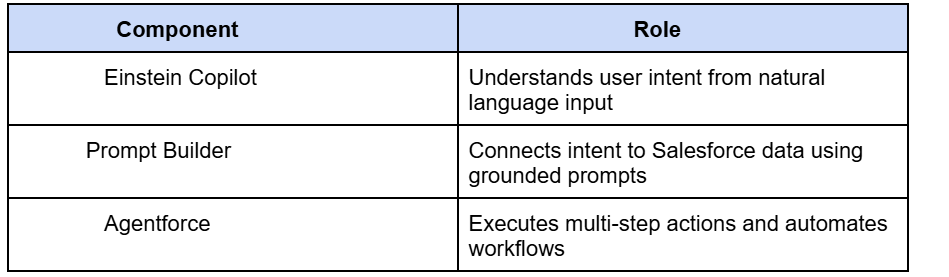
Together, they create agentic workflows that remove manual effort and keep humans focused on higher-level thinking. 💡
🚦 Types of Salesforce AI Agents
According to Salesforce docs, Agentforce supports different agent types based on use case:
1️⃣ Retrieval Agents
Great for search, recommendations, or knowledge lookups.
2️⃣ Reasoning Agents
Break down steps, plan actions, and decide what to do next.
(Think of them as the “brains” 🧠)
3️⃣ Action Agents
They do things — create records, update data, trigger flows.
4️⃣ Hybrid Agents
Combine retrieval + reasoning + action for multi-step workflows.
In upcoming parts of the series, I’ll build examples like:
💬 “Generate a proposal” → lookup → calculate → draft → update Opportunity → email → log activity
All agentically done!
🧭 Deterministic vs Prompt-Based Actions — A Key Design Choice in Agentic AI
As you start building agents, one of the most important architectural decisions you’ll make is choosing between deterministic and prompt-based actions. Salesforce highlights this in the Prototype the Agent Trailhead module, and it’s a foundational part of designing safe, reliable AI systems.
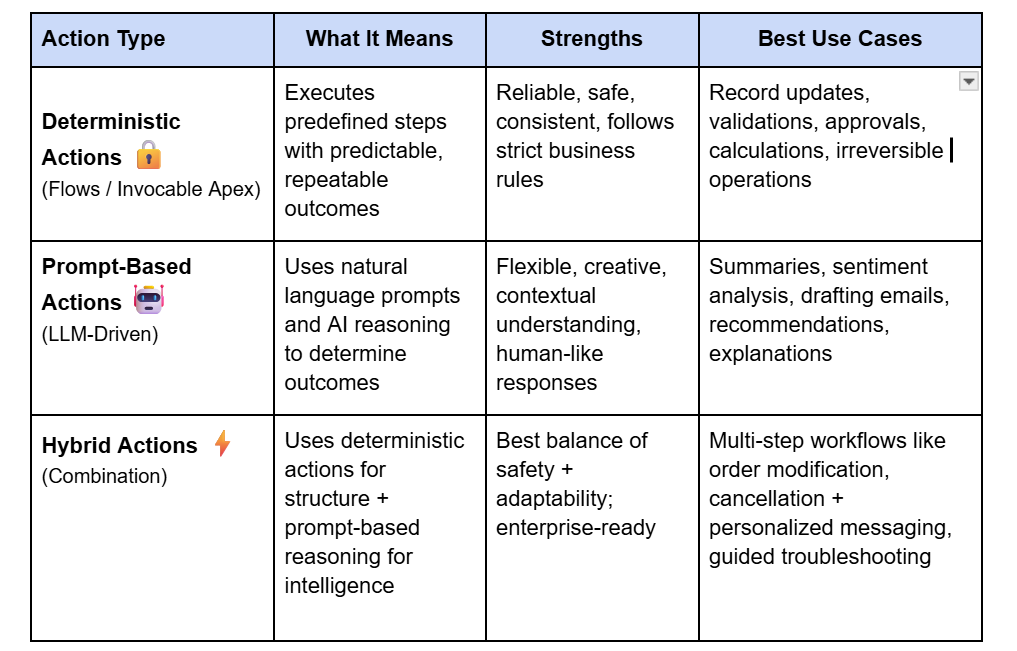
In most real-world solutions, the best approach is hybrid:
- Use deterministic actions for high-impact business logic.
- Use prompt-based reasoning for contextual understanding, conversation, and content generation.
For example:
“Cancel my subscription”
→ Deterministic flow handles cancellation
→ Prompt-based action generates an empathetic message:
“We’re sorry to see you go — could you share what didn’t work?”
This balance keeps the agent safe, smart, and human-like — all at once.
I’ll dive deeper into this in the upcoming articles of this series, where we’ll prototype an actual agent step-by-step. 🚀
🧪 Why Salesforce’s Agentic AI Matters
✔ Eliminates repetitive tasks
✔ Makes CRM processes 10× faster
✔ Reduces human errors
✔ Gives business teams autonomy without developer dependency
✔ Allows developers to scale impact with AI-first architectures
And the best part?
It’s all native, secure, and trust-layer protected 🔒.
📚 What I Used as Sources
- Salesforce Trailhead: Einstein Copilot Basics
- Salesforce Docs: Copilot Overview
- Salesforce Docs: AI Agent Types & Setup
🎉 Final Thoughts
Agentic AI isn’t the future — it’s the now.
If you’re in Salesforce development, architecture, or admin work, this is your moment to embrace the shift.
This article is Part 1 of my Agentic AI Series.
Next up:
👉 Part 2: How to Build Your First Einstein Copilot Prompt (Real Example)
 Jyoti Agarwal